 EN
Home Skincare
Ideal for daily facial care routines, providing easy-to-use beauty solutions at home.

2026/10/16
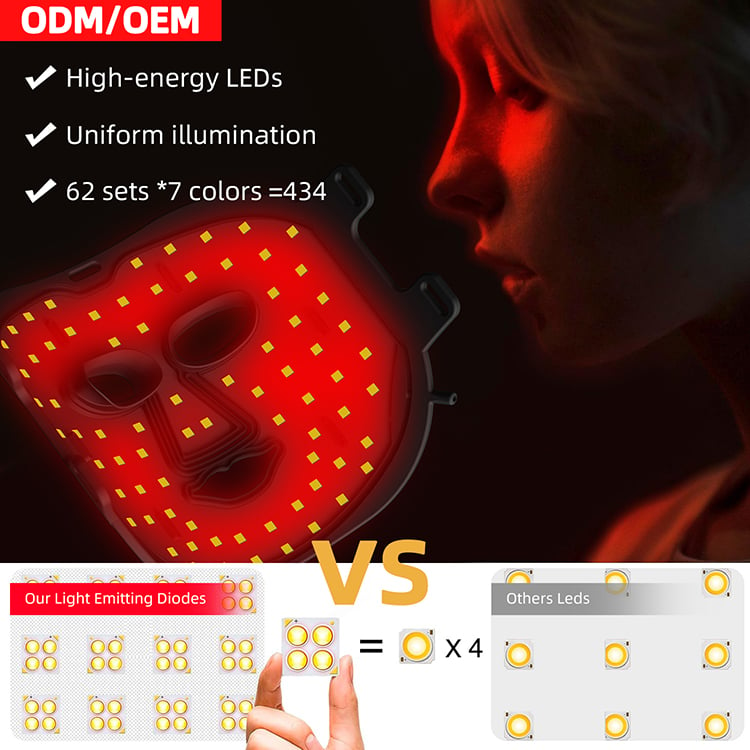
When comparing a red light therapy mask, LED bead count is easy to spot and easy to compare. It is also easy to overvalue. A larger number of LEDs can help a red light therapy mask cover the face more evenly, but count alone cannot tell you how much useful light reaches the skin, where it reaches, or whether the session is comfortable enough to repeat. As a home beauty-device technical adviser, I treat bead count as the start of a specification review; it is not the finish line.
The practical question is not “Which red light therapy mask has the most LEDs?” It is “How do the LEDs, wavelengths, optical output, placement, and red light therapy mask fit work together?” That distinction matters whether you are selecting a consumer device or developing a product brief for a beauty-device brand.
Each LED bead is an emitter. In a red light therapy mask, more emitters may give designers more opportunities to distribute light across broad facial areas such as the forehead, cheeks, nose, chin, and jawline. If two masks use similar LEDs, similar drive conditions, and a similarly shaped shell, the one with a more thoughtful, denser layout may reduce obvious dark gaps between emitters.
That is why bead count matters: it can be a rough clue about coverage potential. It does not, however, measure treatment dose. A 200-bead red light therapy mask can be poorly arranged, under-driven, or too far from parts of the face. A red light therapy mask with fewer well-positioned LEDs may create more consistent at-skin output. In other words, count is a component inventory; it is not a performance measurement.
Faces are not flat. The bridge of the nose projects, eye areas curve inward, and the jaw and temples sit at different distances from a rigid shell. LEDs placed on a flat board can send noticeably different light levels to these contours. A useful red light therapy mask design therefore considers spacing, aiming angle, lens or diffuser behavior, and the distance between the emitters and skin.
Look beyond the total and ask for a layout diagram. Are LEDs present around the upper cheeks and temples? Are they clustered only in the center? Does the eye area have sensible spacing and protection? Does the design use a flexible interface or a contoured shell that keeps a repeatable distance? These details reveal more about uniformity than “300 LEDs” printed on a product page.
Extra emitters can be valuable when they fill real gaps rather than simply increasing the count in already bright central zones. For example, a face-and-neck format needs enough distribution to serve two separate surfaces. A multi-wavelength red light therapy mask also needs a sensible allocation by channel. If red and near-infrared LEDs alternate or share positions, the specification should state how each channel is arranged and controlled—not just give a combined total.
More is not automatically better. Closely packed LEDs may increase heat, require lower drive current, or make thermal management harder. Good engineering balances coverage, output stability, battery or power design, comfort, and the recommended session length.
Irradiance describes optical power over an area, commonly expressed as mW/cm². Fluence, often expressed as J/cm², depends on irradiance and exposure time. That means a red light therapy mask needs more than an LED total to communicate how much light is delivered during a session. The manufacturer should explain where and how irradiance was measured, ideally at the skin-facing treatment surface rather than only directly in front of a single emitter.
Published photobiomodulation discussions commonly distinguish red wavelengths around 630–660 nm and near-infrared wavelengths around 830–850 nm. Those ranges provide context, not a universal recipe. The reported wavelength, irradiance, session duration, and mode of operation all belong in the same conversation. Research also describes a biphasic dose response, so chasing maximum output—or maximum bead count—without a controlled treatment protocol is not a sound selection method.
Use a system comparison instead of a single-number comparison. The table below turns an eye-catching count into questions a buyer can actually verify.
| Specification | Why it matters | What to ask |
|---|---|---|
| Total LED count | Can indicate the potential for broader emitter distribution. | How many emitters are used for each wavelength or light mode? |
| LED layout | Influences coverage across curved facial areas. | Can you provide a placement diagram or uniformity test approach? |
| Wavelength disclosure | Shows what type of light the emitter is designed to produce. | What are the nominal wavelengths and tolerances for each channel? |
| At-skin irradiance | Helps relate output to treatment time. | At what distance and at which facial zones was it measured? |
| Session controls | Support consistent, repeatable use. | What timer, intensity, and heat-management controls are included? |
| Fit and eye comfort | Distance and usability affect real-world consistency. | How does the red light therapy mask fit different face shapes, and what eye-protection design is used? |
Imagine Mask A has 240 LEDs concentrated around the forehead and central cheeks. Mask B has 180 LEDs but uses a more even pattern across the forehead, cheekbones, chin, and jawline, with disclosed measurement conditions. It would be premature to call Mask A stronger simply because it has more beads. If Mask B maintains a more consistent skin-facing distance and its output is verified across multiple positions, it may be the more useful design for its intended protocol.
This is a common selection trap: a high count feels objective, while layout and measurement notes require more attention. Yet the second set of details is what turns a component list into an understandable product system. For an OEM or ODM brief, request both the bead-count breakdown and a coverage-validation plan before locking a cosmetic housing or marketing claim.
BEPERFECT works with home beauty-device brands on ODM development, where these decisions should be connected early: optical layout, industrial design, user comfort, packaging, and the documentation needed for the target market. The right brief is specific about the intended user experience and verification method rather than promising results from a diode number alone.
LED bead count matters in a red light therapy mask because it can influence how completely and evenly a design covers the face. But it is only one part of the evaluation. Treat a high count as an invitation to examine the layout, wavelength allocation, irradiance measurement, session controls, heat, fit, and safety documentation. A transparent specification set is more valuable than the biggest number on the box—and it gives brands and buyers a more reliable basis for comparison.

2026/10/30
Discover why in-house mold development helps an RF beauty device manufacturer improve product consistency, iteration speed, tooling control, and production readiness.

2026/10/30
Learn how to verify an RF beauty device manufacturer's R&D and prototyping capabilities using practical engineering workflows and audit checklists.

2026/10/30
Learn what shapes MOQ when choosing an RF beauty device manufacturer and how to plan a lower-risk first order with balanced platform and customization.

2026/10/30
Use this RF beauty device manufacturer evaluation checklist to compare safety evidence, OEM and ODM capability, quality control, and launch readiness.

2026/10/30
See how technology makes beauty at home more guided, consistent, and informed—plus a practical checklist for choosing devices wisely.

2026/10/30
Explore how AI and smart devices shape the future of beauty with responsive routines, clear guidance, trustworthy design, and user-controlled care.

Ideal for daily facial care routines, providing easy-to-use beauty solutions at home.

Perfect for spas and salons’ frequent treatments, enhancing client experiences and results.

Supports dermatologists with advanced devices for professional skin therapy sessions.

Delivers innovative solutions for full-body massage and relaxation with home devices.

Features anti-aging technologies to help reduce wrinkles and stimulate skin vitality.

Specialized devices for safe and effective hair removal suitable for home or clinic use.

Our customers love the Perfect Idea beauty devices. Quality, packaging, and results are all outstanding. We saw increased repeat sales after adding their facial cleansers to our lineup. Their support team is responsive and reliable.

Perfect Idea brings innovation and reliability to home beauty appliances. Our collaboration introduced their massage tools to Japanese women, boosting customer satisfaction and growing our brand trust across the region.

We partnered with Shenzhen Perfect Idea Tech for their beauty equipment. The shipping was fast and every product matched our expectations. Their home-use massagers are especially popular with local salons and home users.

The stylish packaging and attractive design make Perfect Idea stand out. French consumers appreciate the easy instructions and visible results. Communication was efficient and orders always arrived on time.

Perfect Idea home use personal care devices have become a favorite with our clients. The beauty device line offers quality at a reasonable price, and technical training for our staff made onboarding easy.

We selected Perfect Idea for our beauty product portfolio and have seen very positive feedback from our customers. Products are easy to market online and the customer support is reliable and helpful.
