 EN
Home Skincare
Ideal for daily facial care routines, providing easy-to-use beauty solutions at home.

2026/09/25
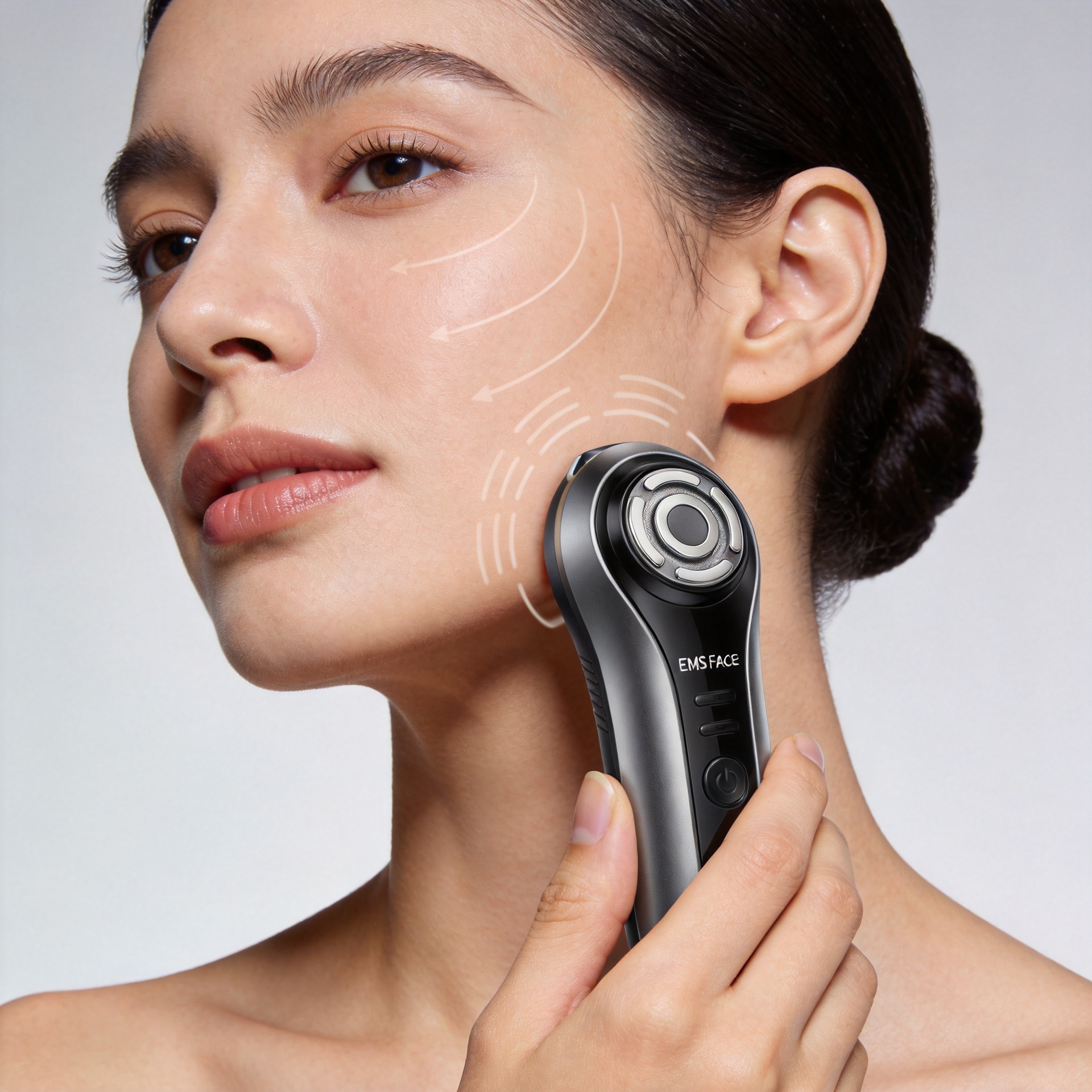
Choosing an EMS face device is less about finding the strongest-looking tool and more about matching its treatment geometry, controls, and instructions to the area you want to address. For product teams, retailers, and private-label buyers, that distinction matters: a broad lower-face applicator, a compact precision head, and an eye-area attachment do not solve the same placement problem. Start with the intended facial zone, then assess whether the device can be used there consistently and safely.
EMS means electrical muscle stimulation. In a facial format, the device delivers controlled electrical pulses through conductive contact points. That basic description should not be confused with a promise of a surgical result or a universal “lifting” outcome. A responsible EMS face selection process focuses on intended use, electrode location, user comfort, and the manufacturer’s labeled instructions.
The face contains many small muscles with different functions. The masseter at the side of the jaw helps close the jaw; the orbicularis oris around the mouth closes and purses the lips; and the orbicularis oculi controls eyelid closure. Muscles associated with the forehead, cheeks, mouth corners, and lower face also sit in different directions and depths. An EMS face device does not need to name every muscle in its marketing, but its applicator design should make the intended zone obvious.
Ask a simple question for each area: can the contact points sit symmetrically on clean, conductive skin without drifting toward a sensitive structure? If the answer is unclear, the device is not a good fit for that area, even if its general product description sounds appealing.
For the upper face, look for a compact head with stable contact points and low, adjustable intensity steps. The goal is controlled placement, not coverage of the entire forehead at once. A handle that is easy to steady in front of a mirror is often more useful than a large pad. The product manual should state the permitted zones clearly and should clearly caution against use close to the eye itself.
Cheek-focused EMS face designs benefit from curved contact surfaces that follow the cheek contour. This makes repeatable positioning easier around muscles involved in facial expression, including the zygomatic region. Compare the width of the applicator with the real usable cheek area: a head that is too wide can cross into areas the user did not intend to treat, while one that is too narrow can make a routine slow and inconsistent.
For the lower face, a U-shaped or dual-contact design may offer a more repeatable path along the jawline than a small point applicator. Check whether the device explains where the contacts should rest and how long a session should last. Do not treat a jawline-shaped tool as proof that it suits every user. Face shape, sensitivity, and the device’s labeled placement directions still govern the decision.
The mouth area calls for precise placement. Because the orbicularis oris is a circular muscle around the mouth, a narrow applicator and clearly marked no-go zones are more important than maximum output. A buyer should examine whether the user instructions explain contact-medium use, movement speed, and when to reduce intensity. Vague directions are a warning sign for any EMS face product intended for this detailed zone.
The eye contour is not a place to improvise. The orbicularis oculi surrounds the eye and controls eyelid movement, so the proximity of the eye makes exact labeling essential. Select an eye-area mode only when the product is specifically designed and labeled for that zone. Avoid devices whose manual uses broad claims but gives no placement diagram, no limitation language, or no dedicated attachment.
For an OEM or ODM brief, convert these points into verification questions: Which zones are in the instructions? What is the contact material? How are intensity levels validated in the user interface? Can the packaging include diagrams and localized safety information for the destination market? A factory partner with end-to-end customization capability can help align industrial design, packaging, and instructions, but finished claims and labeling still need market-specific review.
Read the contraindications and warnings before comparing modes. FDA guidance for powered muscle stimulators includes cautions for people with cardiac demand pacemakers, warns against stimulation over the carotid sinus area, and notes that skin irritation or burns beneath electrodes have been reported. These points are not a substitute for a clinician’s advice, and local regulations may differ, but they show why a credible EMS face device needs clear safety language.
Reject vague instructions such as “use anywhere on the face.” A better product manual identifies permitted zones, contraindications, preparation steps, cleaning, and stop-use conditions such as pain, burning, or marked irritation. Buyers should also confirm the documentation and compliance pathway appropriate to the markets where the finished device will be sold. Do not infer certification or medical clearance from an EMS feature alone.
An EMS face product brief is easier to compare when every EMS face feature is tied to a target zone. Record the EMS face applicator, the EMS face contact material, and the EMS face intensity range rather than relying on a single headline claim. The same worksheet lets a team compare EMS face instructions and EMS face cleaning steps across samples.
| EMS face review point | What the EMS face brief should show |
|---|---|
| EMS face target zone | EMS face placement diagram |
| EMS face contact shape | EMS face spacing and stability |
| EMS face intensity control | EMS face low-start setting |
| EMS face timer | EMS face session limit |
| EMS face feedback | EMS face contact indication |
| EMS face conductive medium | EMS face preparation guidance |
| EMS face eye-area claim | EMS face labeled limitation |
| EMS face jawline format | EMS face symmetric placement |
| EMS face warning set | EMS face stop-use instructions |
| EMS face cleaning | EMS face contact-care process |
| EMS face packaging | EMS face localized instructions |
| EMS face compliance file | EMS face market-review plan |
Use the EMS face sheet during sample review, then repeat the EMS face check after any industrial-design change. This helps an EMS face program preserve clear placement language from prototype to packaging. For a buyer, the EMS face worksheet turns an EMS face comparison into a documented decision instead of a feature-count exercise.
A suitable EMS face device has intended zones, contact design, and safety instructions that match the user’s actual routine. A broad jawline format may be sensible for lower-face placement, while a smaller head may better suit carefully labeled cheek or mouth-area work. Prioritize transparent instructions and controllable settings over exaggerated transformation language. That approach gives users a safer, clearer way to compare EMS face options and gives beauty-device brands a stronger foundation for responsible product development.

2026/10/30
Discover why in-house mold development helps an RF beauty device manufacturer improve product consistency, iteration speed, tooling control, and production readiness.

2026/10/30
Learn how to verify an RF beauty device manufacturer's R&D and prototyping capabilities using practical engineering workflows and audit checklists.

2026/10/30
Learn what shapes MOQ when choosing an RF beauty device manufacturer and how to plan a lower-risk first order with balanced platform and customization.

2026/10/30
Use this RF beauty device manufacturer evaluation checklist to compare safety evidence, OEM and ODM capability, quality control, and launch readiness.

2026/10/30
See how technology makes beauty at home more guided, consistent, and informed—plus a practical checklist for choosing devices wisely.

2026/10/30
Explore how AI and smart devices shape the future of beauty with responsive routines, clear guidance, trustworthy design, and user-controlled care.

Ideal for daily facial care routines, providing easy-to-use beauty solutions at home.

Perfect for spas and salons’ frequent treatments, enhancing client experiences and results.

Supports dermatologists with advanced devices for professional skin therapy sessions.

Delivers innovative solutions for full-body massage and relaxation with home devices.

Features anti-aging technologies to help reduce wrinkles and stimulate skin vitality.

Specialized devices for safe and effective hair removal suitable for home or clinic use.

Our customers love the Perfect Idea beauty devices. Quality, packaging, and results are all outstanding. We saw increased repeat sales after adding their facial cleansers to our lineup. Their support team is responsive and reliable.

Perfect Idea brings innovation and reliability to home beauty appliances. Our collaboration introduced their massage tools to Japanese women, boosting customer satisfaction and growing our brand trust across the region.

We partnered with Shenzhen Perfect Idea Tech for their beauty equipment. The shipping was fast and every product matched our expectations. Their home-use massagers are especially popular with local salons and home users.

The stylish packaging and attractive design make Perfect Idea stand out. French consumers appreciate the easy instructions and visible results. Communication was efficient and orders always arrived on time.

Perfect Idea home use personal care devices have become a favorite with our clients. The beauty device line offers quality at a reasonable price, and technical training for our staff made onboarding easy.

We selected Perfect Idea for our beauty product portfolio and have seen very positive feedback from our customers. Products are easy to market online and the customer support is reliable and helpful.
