 EN
Home Skincare
Ideal for daily facial care routines, providing easy-to-use beauty solutions at home.

2026/09/24
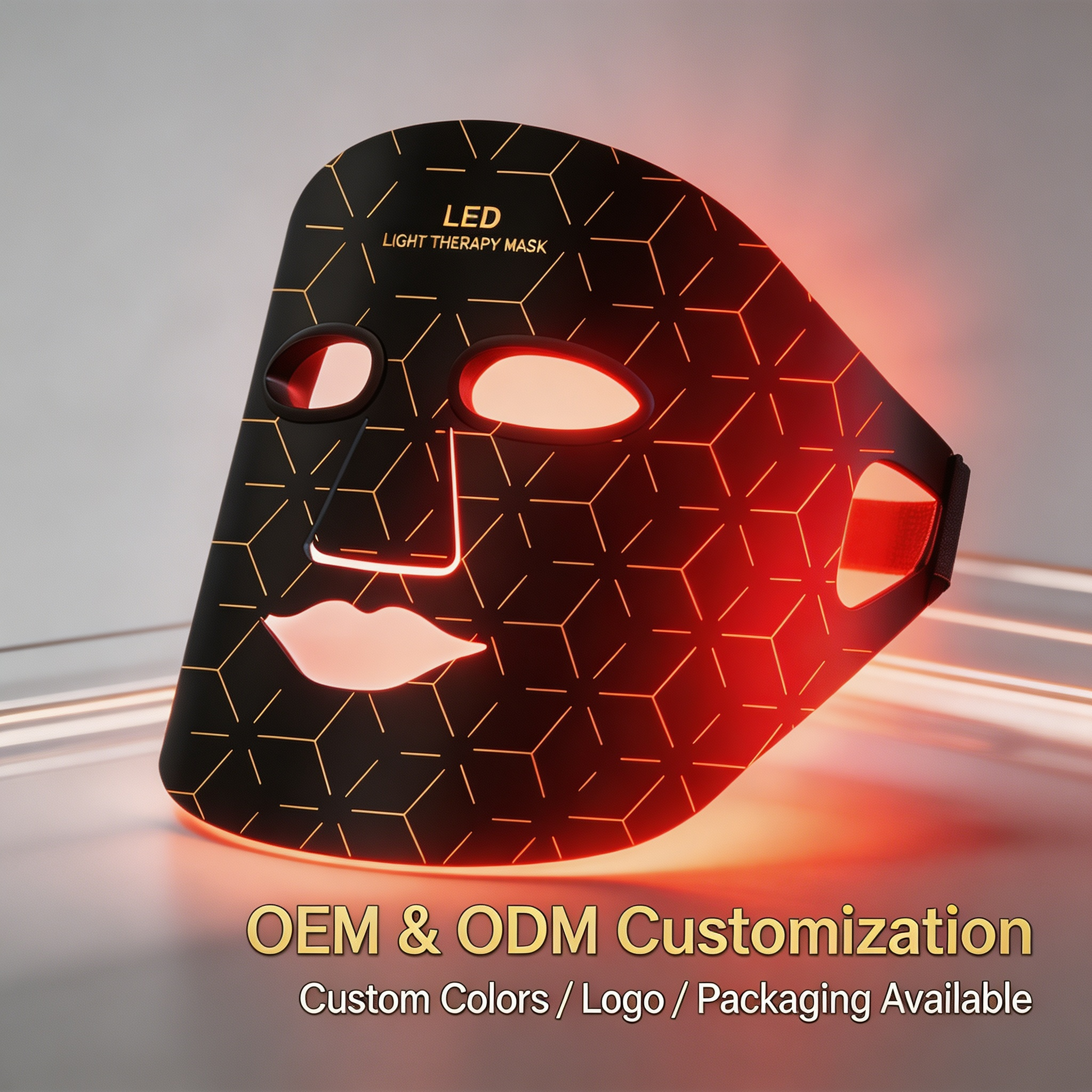
LED light therapy is often explained with a color chart: blue for one concern, red for another, near-infrared for a deeper target. That shortcut is useful for a first conversation, but it misses the important part. Skin is not a flat screen, and light does not switch on one layer while ignoring the rest. A better explanation starts with skin anatomy, the optical properties of tissue, and the dose a device actually delivers.
For beauty-device teams, this matters because a credible LED light therapy message should describe what the device is designed to do without promising that every user will see the same clinical result. Wavelength, irradiance, treatment time, distance from the face, mask fit, and the user’s skin condition all shape the delivered dose.
The outermost stratum corneum is the barrier made of flattened cells and lipids. Beneath it sits the living epidermis, where keratinocytes and pigment-producing cells are active. The dermis below contains connective-tissue structures, fibroblasts, small blood vessels, and sensory nerves. Subcutaneous tissue lies deeper still.
When light reaches skin, some is reflected at the surface, some is absorbed by molecules in the tissue, and some is scattered sideways or forward. In other words, penetration is not a fixed depth printed on a box. It is a distribution of light energy that changes with wavelength, device geometry, contact, skin tone, and local tissue composition. This is why an LED light therapy device should be evaluated as a complete optical system, not as a list of diode colors.
At the surface, even coverage and comfortable fit influence whether a user can follow a routine consistently. The epidermis contains pigments and proteins that interact with incoming light, so the starting dose at the skin surface is not identical to the dose available farther down. Blue-visible wavelengths are generally more strongly scattered and absorbed in superficial tissue than red or near-infrared light. That makes a surface-oriented explanation more appropriate than a claim that blue light reaches every deeper structure.
Blue light is commonly discussed in acne-focused LED light therapy because it can interact with porphyrins associated with Cutibacterium acnes. The practical wording matters: this is one rationale for an acne-oriented protocol, not a guarantee that a consumer device will clear acne. Persistent, painful, or widespread acne should be assessed by a qualified clinician.
For product teams, the epidermal story also reinforces a basic usability rule. A mask that leaves large gaps, shifts during a session, or creates hot spots may produce an uneven experience even when its nominal wavelength is appropriate.
Red light is often used in LED light therapy discussions of skin appearance because it can travel through tissue differently from shorter visible wavelengths. Some of the incident light may reach the upper dermis, where many of the structures associated with skin support and texture are located. Research on photobiomodulation commonly examines how red and near-infrared light may be absorbed by cellular chromophores, including mitochondrial components such as cytochrome c oxidase. The proposed downstream signaling pathways are still an active research area, and the biological response depends on dose.
That nuance is useful. Red light does not “make collagen” on demand, and it should not be presented as a replacement for medical treatment. A more accurate claim is that a well-designed red-light routine may support the appearance of smoother, more even-looking skin for some users when used as directed over time. Results can vary with baseline skin condition, adherence, and the device’s optical design.
Near-infrared light is outside the visible spectrum, so users cannot judge it by brightness. It is often included with red LEDs because its tissue interaction differs from visible light and it is commonly studied in photobiomodulation. Compared with blue light, near-infrared is generally less affected by some superficial absorbers, which is why it is often discussed in relation to deeper tissue exposure.
“Deeper” should not be confused with “better.” A useful LED light therapy design balances wavelength selection with irradiance, exposure duration, thermal management, and eye-safety considerations. More power is not automatically more useful; biological systems can have dose-response limits, and comfort and compliance are part of real-world performance.
A color label alone cannot tell a brand owner or user what happens in skin. Ask four practical questions instead:
This framework shifts the conversation from dramatic before-and-after promises to repeatable design choices. For OEM and ODM programs, it also helps align industrial design, thermal engineering, optical verification, and claims review before launch.
LED light therapy is noninvasive, but noninvasive does not mean universally suitable. Users should follow the device instructions, avoid staring directly at bright LEDs, and seek professional guidance when they have a photosensitivity condition, use photosensitizing medication, have an active skin disorder, or are unsure about a medical diagnosis. Brands should avoid presenting a cosmetic device as a cure for disease or as a substitute for professional care.
The most useful education is specific about these limits. A thoughtful protocol tells users what to expect, when to stop, and when to consult a clinician. That protects users and makes product communication more trustworthy.
Use this concise checklist to translate the layer-by-layer explanation into a responsible routine and product brief.
In summary, LED light therapy works through the interaction of selected wavelengths with skin tissue, not through a simple one-color-one-layer rule. Shorter visible wavelengths are generally discussed for more superficial interactions; red and near-infrared wavelengths are often explored for different tissue exposure patterns and photobiomodulation mechanisms. Across every layer, the delivered dose and the quality of the device design determine what is plausible.
For a beauty-device brand, the strongest message is also the most accurate: explain the intended optical pathway, verify the device’s output and safety features, and set realistic expectations. That gives users a practical reason to use the device consistently without turning a complex skin process into an overpromised result.

2026/10/30
Discover why in-house mold development helps an RF beauty device manufacturer improve product consistency, iteration speed, tooling control, and production readiness.

2026/10/30
Learn how to verify an RF beauty device manufacturer's R&D and prototyping capabilities using practical engineering workflows and audit checklists.

2026/10/30
Learn what shapes MOQ when choosing an RF beauty device manufacturer and how to plan a lower-risk first order with balanced platform and customization.

2026/10/30
Use this RF beauty device manufacturer evaluation checklist to compare safety evidence, OEM and ODM capability, quality control, and launch readiness.

2026/10/30
See how technology makes beauty at home more guided, consistent, and informed—plus a practical checklist for choosing devices wisely.

2026/10/30
Explore how AI and smart devices shape the future of beauty with responsive routines, clear guidance, trustworthy design, and user-controlled care.

Ideal for daily facial care routines, providing easy-to-use beauty solutions at home.

Perfect for spas and salons’ frequent treatments, enhancing client experiences and results.

Supports dermatologists with advanced devices for professional skin therapy sessions.

Delivers innovative solutions for full-body massage and relaxation with home devices.

Features anti-aging technologies to help reduce wrinkles and stimulate skin vitality.

Specialized devices for safe and effective hair removal suitable for home or clinic use.

Our customers love the Perfect Idea beauty devices. Quality, packaging, and results are all outstanding. We saw increased repeat sales after adding their facial cleansers to our lineup. Their support team is responsive and reliable.

Perfect Idea brings innovation and reliability to home beauty appliances. Our collaboration introduced their massage tools to Japanese women, boosting customer satisfaction and growing our brand trust across the region.

We partnered with Shenzhen Perfect Idea Tech for their beauty equipment. The shipping was fast and every product matched our expectations. Their home-use massagers are especially popular with local salons and home users.

The stylish packaging and attractive design make Perfect Idea stand out. French consumers appreciate the easy instructions and visible results. Communication was efficient and orders always arrived on time.

Perfect Idea home use personal care devices have become a favorite with our clients. The beauty device line offers quality at a reasonable price, and technical training for our staff made onboarding easy.

We selected Perfect Idea for our beauty product portfolio and have seen very positive feedback from our customers. Products are easy to market online and the customer support is reliable and helpful.
